
Aximsoft

Helping local teams make sense
of competitor data

How we brought competitor discovery, social analytics, and AI-assisted answers into one workflow for multi-location businesses.

By AximsoftAug. 2018

The challenge

Plenty of data. Too much work to make sense of it.

A social media management platform had extensive data, but its users still struggled to decide what to do next.

Local marketing teams needed to compare nearby competitors, understand which content was connecting with audiences, and use those findings in their own plans.

Limited local context

Finding the right comparisons. Teams needed relevant competitors, not broad market averages.

Complex analytics

Making sense of the numbers. Raw metrics did not clearly explain what deserved attention.

Reactive content decisions

Keeping research up to date. Manual checks made it difficult to follow changes consistently.

The goal was to make competitive research easier to understand and use.
What we built

A connected workflow for research, analysis, and answers

We brought competitor discovery, social data analysis, and recommendations into one experience. The system helps users understand the available information instead of leaving them to interpret another dashboard on their own.

Discover relevant competitors

Find relevant competitors. Use business category and location to identify useful local comparisons.

Turn social signals into insights

Analyze the available signals. Review posts, public feedback, and engagement data for patterns that matter to the question.

Make analytics conversational

Ask questions in everyday language. Retrieve relevant data for supported questions about metrics, businesses, and time periods.

Generate actionable recommendations

Give teams a starting point. Turn findings into summaries and content recommendations for people to review.

Build trust into the AI workflow

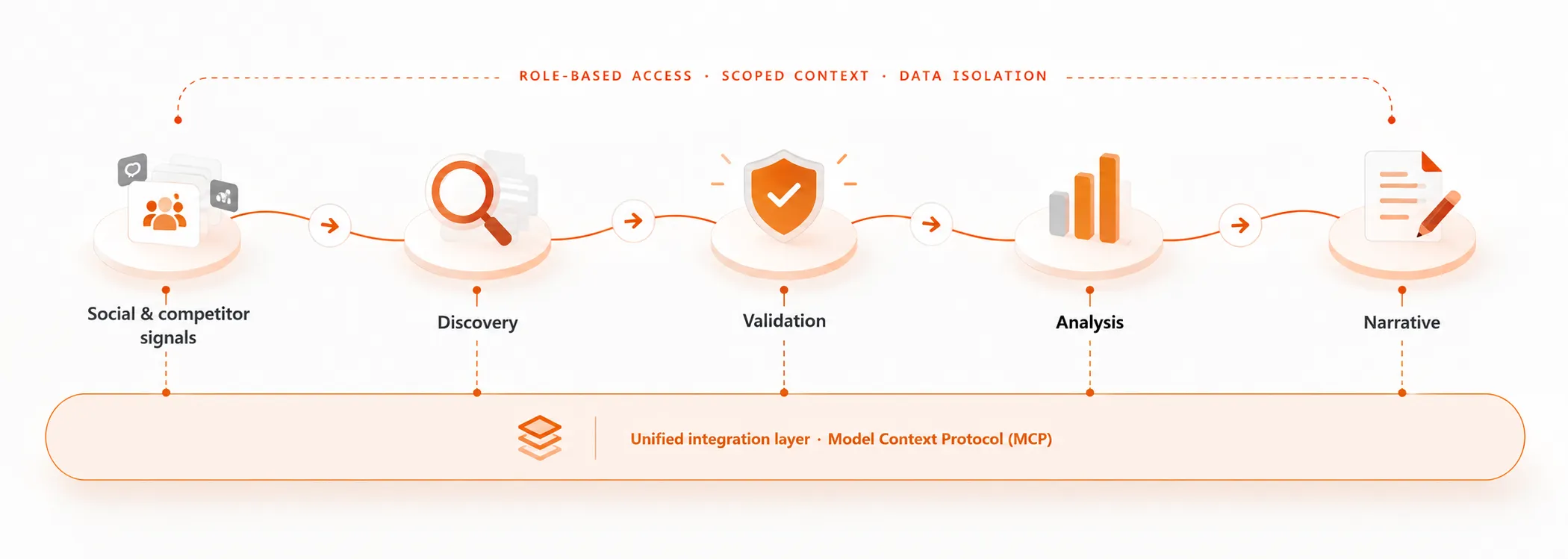
Check the data and control access. Separate discovery, validation, analysis, and writing, with data checks and role-based access throughout.

How it works

From a question to a finding the team can review

Five steps connect the research to the recommendation, with people reviewing the output.

Step 01

Discover

Find competitors using business and location context.

Step 02

Validate

Collect the available data and check whether it can support the question.

Step 03

Analyze

Compare performance and identify relevant patterns.

Step 04

Explain

Present findings and answers in clear language.

Step 05

Recommend

Prepare suggestions and strategy drafts for human review.

Competitive Intelligence AI Multi-Agent Workflow Architecture Diagram

What changed for users

Competitive information became easier to use

Teams gained a clearer view of relevant competitors and a more direct way to investigate their marketing questions.

Better local competitive visibility

More useful comparisons. Local teams could compare their social activity with relevant nearby businesses.

More informed content decisions

Better context for content planning. Competitor activity and engagement patterns helped inform the next plan.

Faster access to insights

Fewer manual reporting requests. Natural-language questions gave users another way to explore supported metrics.

A more scalable intelligence architecture

Room to extend the system. Separate agents and a shared integration layer supported additional analytical workflows.

What we used

What we used to build it.

Multi-agent workflow orchestration
Model Context Protocol integrations
Social and competitor analytics
Natural-language queries
Data validation and contextual retrieval
Role-based access and data isolation

The result

Less time gathering information. More context for decisions.

By connecting discovery, analysis, and explanations, we helped turn social data into a practical research tool for local marketing teams.

Teams could use that context to review their content plans and make more informed choices about what to try next.